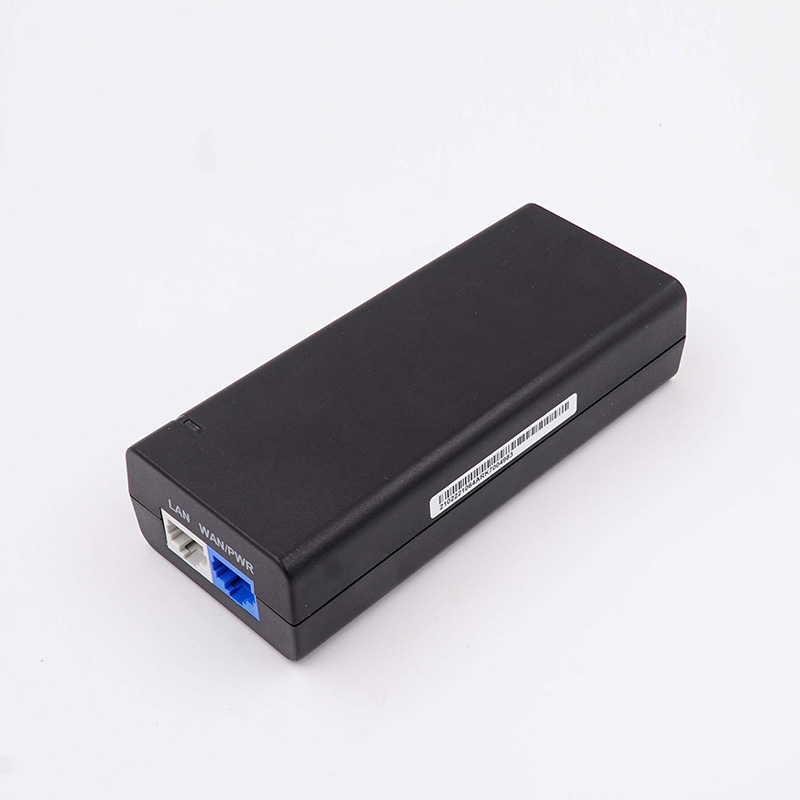
Expanding modern network infrastructure often pushes edge devices into challenging physical locations. We frequently deploy IP cameras, wireless access points, and security panels far beyond the main server room. You need power and data in hard-to-reach places. While a PoE injector solves the immediate power delivery problem without replacing your non-PoE switches, it does not rewrite the laws of physics. Transmission limits depend heavily on strict Ethernet data standards, rather than just raw electrical output.
In this article, we define the hard physical limits of standard PoE networks. We explore the real-world cabling variables causing severe voltage drop. Finally, we provide a reliable technical framework for evaluating long-distance extension solutions. By the end, you will know exactly how to scale your network infrastructure safely and effectively.
Key Takeaways
Standard PoE injectors transmit power and data up to **100 meters (328 feet)**, limited by IEEE 802.3 Ethernet data degradation, not just power loss.
Cable metallurgy (Solid Copper vs. Copper Clad Aluminum) is the primary cause of premature power failure in long cable runs.
Extending beyond 100m requires specific hardware interventions: PoE extenders for moderate distance increases, or fiber optic media converters for extreme long-distance PoE.
Passive PoE injectors experience severe voltage drop over distance compared to active, IEEE-compliant models.
The 100-Meter Baseline: Why IEEE 802.3 Dictates Your Limits
Network engineers often confuse power transmission limits with data transmission limits. Electricity can physically travel hundreds of meters depending on the source voltage and wire gauge. However, standard Ethernet data signals degrade rapidly. High-frequency digital signals begin to attenuate heavily over unshielded twisted pair copper. They lose packet integrity at exactly 100 meters (328 feet). The IEEE 802.3 standard sets this firm boundary to guarantee reliable gigabit network performance.
Understanding standard power budgets helps prevent accidental overloads. An injector negotiates power delivery based on strict IEEE classifications. It supplies a specific wattage, but cable resistance naturally bleeds some energy as heat. The device receives slightly less power than the injector originally outputs.
IEEE 802.3 PoE Power Budgets at Maximum Distance
IEEE Standard
PoE Type
Power at Injector (Source)
Guaranteed Power at Device (100m)
802.3af
Type 1
15.4 Watts
12.95 Watts
802.3at
Type 2
30.0 Watts
25.5 Watts
802.3bt
Type 3
60.0 Watts
51.0 Watts
802.3bt
Type 4
90.0 Watts
71.3 Watts
You must understand the exact role your midspan hardware plays. An Ethernet PoE adapter injects necessary electrical current into the line. It successfully resets the total power budget. However, it does not reset the data distance from the original network switch. The 100-meter physical limit applies to the total continuous cable run. This total includes the patch cable from the switch, the injector itself, and the final run to the edge device.
How Cable Quality and Metallurgy Impact Actual Distance
Pushing power over long distances introduces serious implementation risks. Direct current (DC) resistance becomes a major enemy in network design. Higher power demands from devices like PTZ cameras pull intense current over long, thin copper cables. This inevitably results in voltage dropping below the device's minimum operating threshold. Equipment then fails to boot or malfunctions randomly.
Cable metallurgy dictates your actual transmission success rate. You must choose pure solid copper over Copper Clad Aluminum (CCA). CCA cables exhibit approximately 55% higher DC resistance compared to pure copper. Using CCA guarantees excessive heat generation. It forces premature power failure at distances well under the 100-meter standard limit. Pure copper maintains voltage integrity effortlessly across maximum permitted lengths.
Category ratings also strongly influence overall resistance.
Cat5e cables: Typically use 24 AWG conductors. They function well for basic Type 1 and Type 2 power budgets at shorter distances.
Cat6 and Cat6a cables: Feature thicker 23 AWG conductors. Thicker wire lowers electrical resistance significantly. They are mandatory for high-draw Type 3 or Type 4 long-distance runs.
Throughput considerations matter equally in modern deployments. A standard Gigabit PoE injector easily handles 10/100/1000 Mbps speeds natively. However, pushing true Gigabit speeds to the absolute edge requires flawless Cat6 terminations. Poor crimping or untwisted pairs introduce near-end crosstalk (NEXT). This crosstalk ruins throughput even if the power delivery remains stable.
Active vs. Passive PoE Injectors Over Distance
Choosing the correct injector type prevents disastrous hardware damage over long distances. Active PoE follows the strict IEEE standard guidelines perfectly. It uses a low-voltage handshake protocol before supplying main power. The injector checks the end device for proper signature resistance. If the line resistance is too high, or the cable is compromised, the injector safely withholds power. This intelligent negotiation prevents electrical fires and protects expensive network switches.
Conversely, a passive PoE injector introduces substantial distance risks. Passive models skip the handshake protocol entirely. They supply "always-on" voltage continuously down the cable pairs. You usually see these configured for fixed 24V or 48V outputs. This blind power delivery causes major issues during extended cable runs.
Because there is no active negotiation, long cable runs suffer profound voltage drop. A 24V passive supply might only deliver 18V by the time it travels 150 feet. The end device expects 24V but starves for current. This starvation causes IP cameras or wireless access points to reboot continuously. They might function erratically or fail completely during high-load operations. Active models easily compensate for minor voltage drops, while passive models fail silently.
Evaluating Solutions for Long-Distance PoE (Beyond 100m)
When physical limits constrain your deployment, you need specific hardware interventions. Several distinct technologies help you push past the 100-meter barrier safely. You must select the solution matching your bandwidth needs and power budget.
Solution A: PoE Extenders (Repeaters)
PoE extenders offer a simple inline solution. They draw operating power directly from the incoming PoE line. The extender regenerates the data signal cleanly and passes the remaining electrical power forward. This grants you another full 100-meter run.
They remain incredibly budget-friendly and easy to deploy. However, you must calculate power consumption carefully. Each extender consumes a portion of your total power budget, typically 2 to 4 Watts. Daisy-chaining multiple extenders drains the budget quickly. The initial injector's total wattage heavily limits how many extenders you can string together.
Solution B: Long-Reach PoE Switches and Injectors
Certain proprietary hardware enables highly extended copper runs. Long-reach technology forces the data transmission rate down to exactly 10 Mbps. By reducing the frequency, the signal survives much longer distances. This method achieves spans up to 250 meters (820 feet) over standard cable.
You should deploy this solution only for specific use cases. It suits low-bandwidth environmental sensors or basic static IP cameras perfectly. It remains entirely unacceptable for high-resolution multi-sensor cameras or dense Wi-Fi 6 access points. Those devices require maximum gigabit throughput to function correctly.
Solution C: Fiber Optic Media Converters
Fiber optic networking solves extreme distance limitations permanently. Media converters change standard copper Ethernet data into light pulses. This transition pushes data miles away without attenuation. Fiber converters rely on localized power sources or specialized composite fiber-copper cables to power the remote device.
This method requires the highest initial investment. However, it delivers maximum network security and virtually infinite scalability. Fiber optics also remain completely immune to electromagnetic interference (EMI). This makes fiber the superior choice for industrial long-distance PoE deployments traversing heavy machinery environments.
Decision Framework: Specifying the Right Equipment
Designing a reliable extension strategy requires strict operational planning. Guessing your power budgets will result in offline edge devices. Follow this straightforward framework to specify the exact hardware needed for your next deployment.
Audit the Power and Bandwidth Requirement: Calculate the absolute peak draw of the end device. Do not rely on idle draw statistics. PTZ cameras consume massive power during pan-tilt movements. You must also measure the exact bandwidth needed to sustain peak operations.
Assess the Existing Infrastructure: Evaluate your current copper cabling objectively. Are you using existing Cat5e drops, or pulling fresh Cat6? If pulling new runs, mandate solid bare copper explicitly. Reject any vendor supplying copper-clad aluminum for PoE installations.
Select the Extension Hardware:
Under 100 meters: Deploy standard Active PoE Injectors matching your power class.
100 meters to 200 meters: Install a ruggedized inline PoE extender to regenerate the data signal safely.
Over 200 meters: Transition immediately to fiber optic media converters. Do this especially in outdoor areas carrying high lightning risks, as fiber does not conduct electrical surges.
Conclusion
Distance limits in network engineering remain strict rules governed by physics and IEEE data standards. They are not arbitrary suggestions or flexible marketing claims. Standard power and data transmission ends reliably at 100 meters over twisted pair copper. Attempting to push basic hardware past this boundary invites intermittent failures, packet loss, and severe voltage drops.
To ensure total reliability, you must specify robust materials and capable hardware. Verify your cable specifications thoroughly to confirm you are installing pure solid copper. Calculate your complete total power budget, including the draw of any inline extenders, before purchasing extension hardware. Taking these calculated steps guarantees your remote devices stay online permanently.
FAQ
Q: Does a Gigabit PoE injector give me more distance than a Fast Ethernet (10/100) injector?
A: No. Data speed does not increase your physical transmission distance. Higher frequency gigabit signals are actually more sensitive to signal degradation and crosstalk. Both speeds share the strict 100-meter physical boundary defined by IEEE standards.
Q: Can I daisy-chain two PoE injectors to double the distance?
A: No. Injecting electrical power twice does not regenerate the degrading data signal. A second injector will just reset the power budget. You strictly need an active PoE extender to repeat the data packets over longer runs.
Q: Why is my IP camera rebooting at 250 feet?
A: You are likely experiencing severe voltage drop. This is commonly caused by utilizing a passive injector, deploying inferior copper-clad aluminum (CCA) cabling, or suffering from degraded physical terminations. These factors increase line resistance drastically.
UE Electronic is a power supplier integrating R&D, production and sales. We maintain a leading level in extension cord and GaN charger.We are committed to becoming a global power supplier.