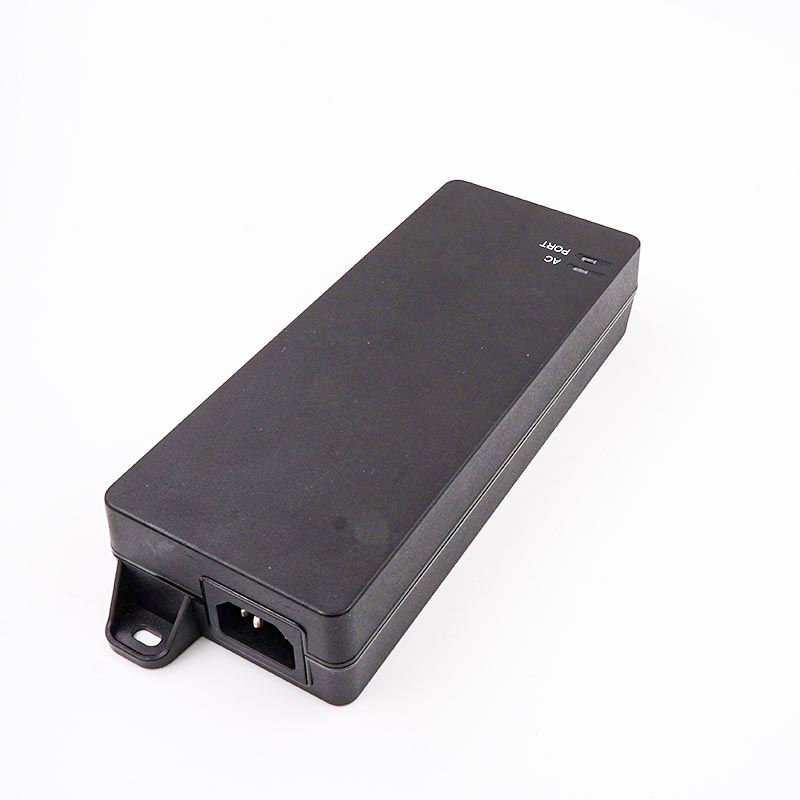
Upgrading network edge devices often requires more power than legacy switches can provide. Access points and PTZ cameras constantly evolve. They demand higher energy inputs. Replacing entire network switches just for a few new devices is cost-prohibitive. PoE Injectors effectively bridge this gap. They deliver targeted data and power over a single Ethernet cable. You avoid expensive infrastructure overhauls. However, selecting the wrong IEEE standard causes serious problems. It leads to device underperformance, unexpected reboots, or wasted IT budgets. This article provides a strict, specification-based breakdown of the three major Power over Ethernet standards. You will learn the exact technical boundaries of each protocol. We will also help you facilitate accurate, risk-free hardware procurement for your next deployment.
Key Takeaways
IEEE 802.3af (PoE): Delivers up to 15.4W at the source; ideal for basic VoIP phones and static IP cameras.
IEEE 802.3at (PoE+): Delivers up to 30W; the current baseline for most dual-band access points and standard PTZ cameras.
IEEE 802.3bt (PoE++): Delivers 60W (Type 3) to 90W (Type 4); mandatory for Wi-Fi 6/7 APs, digital signage, and advanced IoT devices.
Safety First: Always prioritize an active PoE injector to ensure proper device handshaking and prevent accidental voltage damage to non-PoE equipment.
Infrastructure Reality: High-power injections (802.3bt) require strict attention to cable grade (Cat6/Cat6a recommended) due to thermal dissipation risks.
The Three Core IEEE Standards: Specifications and Output
You must understand the technical boundaries of each standard before evaluating hardware. We need a solid baseline. We evaluate power at two critical points. The Power Sourcing Equipment (PSE) represents the injector output. The Powered Device (PD) represents the actual hardware receiving energy. Power drops over long cable runs due to copper resistance. Therefore, PSE numbers always exceed PD numbers.
IEEE 802.3af (Type 1) The IEEE ratified this foundational standard in 2003. It supports legacy devices requiring minimal power. • PSE maximum output: 15.4W. • PD maximum received: 12.95W. This accounts for expected cable loss over a 100-meter run. • Supported PoE Classes: 0–3. An IEEE 802.3af PoE injector utilizes two pairs of twisted copper wires for power delivery. We rarely recommend it for modern, high-performance hardware. It works flawlessly for basic infrastructure.
IEEE 802.3at (Type 2 / PoE+) The industry needed more power for complex devices. The IEEE introduced this upgraded standard in 2009. • PSE maximum output: 30W. • PD maximum received: 25.5W. • Supported PoE Class: 4. This standard remains completely backwards compatible. It safely powers Class 0-3 devices. This standard forms the backbone of standard enterprise deployments today.
IEEE 802.3bt (Type 3 & 4 / PoE++) Modern edge devices draw massive energy. The IEEE released the 802.3bt standard in 2018 to solve this challenge. It utilizes all four wire pairs in the Ethernet cable. • PSE maximum output: 60W (Type 3) and 90W (Type 4). • PD maximum received: 51W (Type 3) and 71.3W (Type 4). • Supported PoE Classes: 5–8. This standard enables true smart-building automation. It pushes the absolute physical limits of standard copper Ethernet cables.
Common Mistake: Network admins often read the PSE wattage and assume their endpoint will receive that exact amount. Always calculate your power budget based on the PD maximum received wattage. Cable resistance constantly turns a small percentage of energy into heat.
Side-by-Side Evaluation: Matching Specs to Power Budgets
Decision-makers need a clear, scannable comparison framework. You must evaluate hardware requirements against strict power budgets. We use the matrix below to standardize procurement decisions.
Power over Ethernet Standards Comparison Matrix
Standard
IEEE Name
Max Port Power (PSE)
Min Cable Requirement
Typical Use Case
PoE (Type 1)
802.3af
15.4W
Cat3 / Cat5e
Basic IP cameras, standard VoIP
PoE+ (Type 2)
802.3at
30W
Cat5e
Dual-band APs, standard PTZ cameras
PoE++ (Type 3)
802.3bt
60W
Cat6
Video conferencing systems, advanced POS
PoE++ (Type 4)
802.3bt
90W
Cat6a
High-density Wi-Fi 7, digital signage
How do we properly calculate budgeting logic? You must read device specification sheets carefully. Determine the true power draw during peak operations. A PTZ camera might idle at 12W. It seems fine for an 802.3af power source. However, what happens when the pan-tilt motors activate? What happens when the infrared night-vision LEDs turn on? The power draw spikes to 22W. The camera instantly crashes and reboots. You must base your procurement on the absolute maximum peak load.
Backwards compatibility provides massive relief for network engineers. You can confidently deploy an 802.3bt injector for older hardware. It will safely power 802.3af and 802.3at devices. The injector never over-supplies voltage. It negotiates the exact power requirement during the initial connection handshake. It only delivers what the endpoint explicitly requests.
Device Shortlisting: Which Injector Fits Your Hardware?
We must map technical specifications to specific, real-world deployment scenarios. Let us look at feature-to-outcome mapping. This helps you purchase the exact equipment required.
When to buy an 802.3af injector: Reserve this standard for lightweight infrastructure. Legacy IoT deployments utilize it heavily. Simple access control card readers require very little energy. Standard 1080p fixed IP cameras run perfectly on 15.4W. Basic desktop VoIP handsets operate smoothly here. Choose this standard only when deploying simple, single-function endpoints.
When to step up to an IEEE 802.3at PoE injector: Most modern enterprises default to this tier. You need this power for dual-band 802.11ac or 802.11ax Wi-Fi access points. Video-enabled IP phones demand more energy for their screens. Complex alarm systems rely on it. An IEEE 802.3at PoE injector easily handles standard PTZ cameras. However, you must verify the camera lacks extreme environmental heaters or heavy duty blowers. Those accessories push the budget too high.
When you must use an 802.3bt injector: Next-generation hardware strictly requires Type 3 or Type 4 power. High-density Wi-Fi 6E and Wi-Fi 7 access points contain multiple power-hungry radio chains. They demand 60W to function at full capacity. 4K outdoor PTZ cameras require heaters to prevent lens freezing. LED intelligent lighting systems run entirely on Ethernet now. Point-of-Sale (POS) terminals and thin clients also rely on an IEEE 802.3bt PoE injector. Do not under-power these critical assets.
Active vs. Passive PoE: Why Compliance and Security Matter
We must address a critical evaluation dimension: device safety. Not all power delivery methods follow the rules. Choosing between active and passive delivery impacts your network integrity.
Let us explain the handshake protocol. An active PoE injector uses strict IEEE-compliant negotiation. It senses a specific 25k Ohm signature resistance on the connected endpoint. The injector verifies the endpoint actually needs power. It determines the correct classification. It sends the voltage only after confirming these safety checks. If you plug a standard laptop into an active injector, nothing happens. The injector senses no resistance. It safely transmits only data.
Passive injectors bypass this handshake entirely. They pose a massive risk. A passive injector forces a continuous 24V or 48V down the line. It acts "always-on." It never checks the receiving endpoint. You will instantly fry the network interface card (NIC) if you accidentally connect a non-PoE laptop. You might destroy an expensive, non-compatible network switch port.
Purchasing Advice: Never cut corners here. Standardize exclusively on IEEE-compliant active injectors. Enterprise, commercial, and high-value home networks require this security. Active negotiation mitigates hardware liability. It prevents catastrophic electrical damage caused by simple patching errors.
Implementation Risks: Cabling and Deployment Realities
Spec sheets look perfect on paper. Field deployments reveal a different reality. We must address common failure points to ensure reliable operation.
Cable heat poses a serious threat during 802.3bt deployments. High wattage over long cable runs causes significant thermal build-up. Pushing 90W through thin copper wires generates dangerous heat. The heat increases electrical resistance. This drops the delivered voltage even further. You must upgrade to Cat6 or Cat6a cabling for 60W and 90W deployments. These cables feature thicker copper conductors (usually 23 AWG). Thicker conductors dissipate heat effectively. Never bundle high-power cables tightly in large groups. Heat gets trapped in the center of the bundle.
Distance limitations remain absolute. The IEEE strictly limits Ethernet data and power transmission to 100 meters (328 feet). This includes all patch cables in the channel. Voltage drops sharply after this limit. Data packets suffer catastrophic collision rates. You will experience random disconnects. You must install active PoE extenders if you need to reach beyond 100 meters.
Avoid the perils of daisy-chaining. Inexperienced installers sometimes try to split injected power downstream. They use cheap splitters to run two cameras off one cable. This violates standard power budgets. It causes severe voltage fluctuations. Endpoints will reboot endlessly. You must use proper PoE passthrough switches if you intend to distribute a single high-power feed to multiple edge devices.
Conclusion
Network edge devices continue to grow more sophisticated. Choosing the right power delivery method ensures stable, long-term operations. Buy the 802.3af standard for basic, legacy needs. Upgrade to the 802.3at standard for modern network baselines. Invest in the 802.3bt standard for high-draw, next-generation IoT devices.
Take these actionable steps before purchasing your hardware. First, audit the "Max Power Consumption" metric on your target device datasheet. Do not look at the average draw. Second, physically check your existing cable gauge. Ensure you have 23 AWG or 24 AWG solid copper wire for high-power runs. Finally, ensure your shortlisting focuses exclusively on IEEE-compliant active hardware. These steps protect your infrastructure and maximize device uptime.
FAQ
Q: Can I use an 802.3bt injector on an 802.3af device?
A: Yes. Active PoE standards are fully backwards compatible. The injector will only supply the power the end device requests. It negotiates the required wattage safely before sending any voltage down the line.
Q: What happens if I use an 802.3af injector on an 802.3at device?
A: The device may fail to boot entirely. Alternatively, it might boot but continuously crash or reboot during peak operations. This happens when a camera moves its motors or an access point handles sudden high traffic.
Q: Do PoE injectors slow down network speed?
A: No. Assuming you purchase a Gigabit or Multi-Gigabit (2.5G/5G/10G) rated injector, data transmission speeds remain unaffected. The power and data travel simultaneously on different frequencies without interference.
Q: How do I know if my PoE injector is active or passive?
A: Look for strict IEEE 802.3af/at/bt compliance on the device label. Passive injectors typically only list a static voltage output (e.g., "24V PoE" or "48V Passive"). They rarely mention official IEEE standards.
UE Electronic is a power supplier integrating R&D, production and sales. We maintain a leading level in extension cord and GaN charger.We are committed to becoming a global power supplier.