Powering edge devices like IP cameras, VoIP phones, and Wi-Fi 6/7 access points presents a significant operational challenge. Network architects must constantly balance upfront capital expenditure against long-term network reliability. You face a critical decision when expanding your infrastructure. Should you upgrade your existing non-PoE network, or should you deploy a completely new end-to-end architecture? Choosing the wrong approach often leads to stranded port capacity. It can also cause unexpected hardware failures due to blown power budgets.
This article provides a comprehensive technical and financial evaluation framework for making this exact decision. We will explore how to choose between localized power delivery and centralized distribution. You will learn how port density, maximum power requirements, and diagnostic management needs directly influence this hardware choice. By objectively analyzing both options, you can confidently architect a highly resilient network. This approach powers your critical edge devices efficiently while preparing your physical infrastructure for future technological expansion.
Key Takeaways
Scale dictates the solution: PoE injectors are cost-effective for localized, low-density expansions; PoE switches are required for scalable, high-density environments.
Power budgets matter: High-draw devices (PTZ cameras, Wi-Fi 7 APs) may overwhelm a standard switch's total power budget, necessitating targeted high-wattage active PoE injectors.
Management capabilities differ: PoE switches offer remote power cycling, SNMP monitoring, and VLAN tagging per port, which standalone midspan injectors natively lack.
Infrastructure footprint: Injectors add physical clutter and potential points of failure; switches centralize power and data delivery.
Defining the Hardware: Midspan vs. Endspan Power Delivery
Network power delivery generally falls into two distinct architectural categories. We refer to these as endspan and midspan solutions. Understanding the mechanical differences helps you prevent accidental hardware damage. It also simplifies your future troubleshooting workflows.
The PoE Switch (Endspan)
An endspan device functions as both your data switch and your power source equipment. Network engineers often refer to this simply as the PSE. The switch delivers power directly over the twisted-pair Ethernet cable. This delivery travels straight from your central server rack directly to the powered device. We call the receiving endpoint the PD.
Endspan architecture provides a highly unified network topology. You manage data routing and electrical transmission from the exact same hardware chassis. This centralization makes monitoring exceptionally straightforward. It requires fewer physical cables. It also eliminates the need for auxiliary power strips inside your network closet.
The PoE Injector (Midspan)
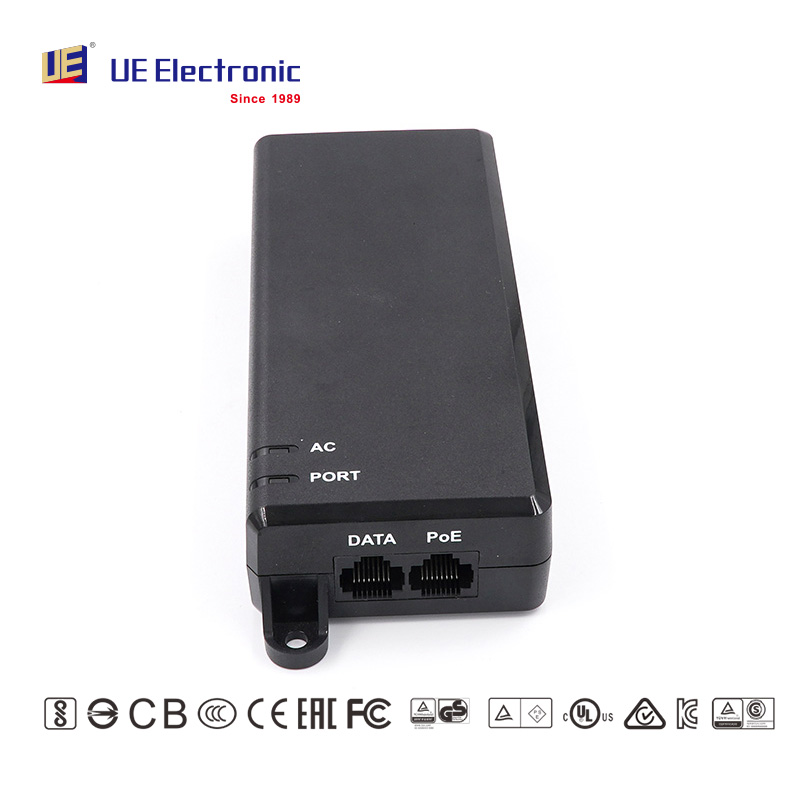
Conversely, you might choose an intermediary device. A midspan injector sits directly between a legacy non-PoE switch and your endpoint. It functions as a dedicated Ethernet power injector. The device takes a standard data signal from your switch. It then merges electrical direct current into that same network cable.
Hardware selection here carries critical safety implications. You must always select an active PoE injector for enterprise deployments. Active models strictly comply with IEEE standards. They actively negotiate voltage requirements by looking for a specific resistance signature on the receiving device. If they do not detect this signature, they withhold power.
Passive models behave very differently. They blast continuous voltage down the cable regardless of the endpoint. They never negotiate power. Connecting a passive model to a non-PoE device risks severe hardware damage. It can literally burn out the network interface card on your receiving equipment. Always avoid passive units in professional environments.
Key Evaluation Dimensions for Network Architects
Choosing between these two technologies requires more than a simple price check. You must evaluate your physical environment across several specific technical dimensions. Let us break down the core criteria network architects use during the procurement process.
Port Density and Cost per Port
Scale remains the most decisive factor in this hardware debate. Port density heavily influences your financial efficiency. If your deployment requires powering only one to three devices, localized injection makes sense. Standalone units offer a significantly lower upfront cost. They allow you to preserve your existing non-PoE switch investments. You avoid replacing perfectly good core routing hardware.
However, the financial math flips when you surpass three devices. Once you deploy four or more endpoints, a centralized PoE switch becomes financially and operationally viable. Buying five individual injectors often costs more than a dedicated 8-port switch. A switch dramatically reduces your cost-per-port at scale. Furthermore, it eliminates your dependency on finding available AC power outlets near your server rack.
Total Power Budgets (PoE, PoE+, PoE++)
Evaluating switch power limits prevents catastrophic network failures. Every switch carries a strictly defined maximum power budget. Network administrators often ignore this specification until their cameras suddenly reboot.
Consider a standard 24-port switch. It might only have a 190W total power budget. If you fully populate this switch with devices drawing 15W each, the math fails. Twenty-four devices at 15W require 360W. The switch will abruptly cut power to random ports to protect its internal circuitry. You will experience rolling blackouts across your security cameras.
Targeted injection solves this specific power limitation. Using a 60W or 90W (802.3bt) injector is highly efficient for isolated heavy-draw devices. Modern PTZ cameras and Wi-Fi 7 access points demand enormous power. By offloading these heavy endpoints to dedicated midspan hardware, you protect your primary switch. The rest of your standard 802.3af/at devices remain perfectly stable.
Network Management and Diagnostics
Management capabilities severely divide these two hardware choices. Modern enterprise switches offer robust Layer 2 and Layer 3 management. You can configure granular VLANs. You can assign Quality of Service rules per port.
Most importantly, switches enable remote port cycling. If an outdoor IP camera freezes, you simply log into the switch console. You turn off the power to port 12. You wait ten seconds, then restore it. The camera reboots successfully. You resolve the outage in two minutes. You completely avoid rolling a truck and sending a technician to the site.
Standard injectors provide zero management intelligence. They operate as unmanaged physical layer devices. They do not have IP addresses. They do not support SNMP monitoring. If a device connected to an injector freezes, a human must physically unplug the cable. This limitation makes them highly unsuitable for remote or inaccessible deployment locations.
Implementation Realities and Deployment Risks
Theoretical network designs often fail during physical installation. The physical realities of cabling, space, and safety regulations introduce strict constraints. You must account for these environmental variables before purchasing your hardware.
Cable Constraints and Thermal Risks
Deploying power over thin Ethernet cables introduces severe thermal risks. Many integrators mistakenly use 30AWG slim Cat6a cables in modern server racks. These thin conductors lack the physical mass to dissipate heat efficiently.
When you push high voltage through thin cables, you experience significant voltage drop. The cable converts the lost energy into heat. This problem escalates dangerously in dense cable bundles. The National Electrical Code strictly regulates bundle sizes for this exact reason. High-power injectors exacerbate this problem if your cabling is sub-standard. You must always pair 60W or 90W delivery with robust 23AWG or 24AWG copper cabling.
Points of Failure and Space Limitations
Physical space limitations often force architectural changes. Deploying multiple midspan units creates a frustrating "spaghetti" environment inside your server room. They dangle from racks. They require a maze of patch cables.
Each unit consumes an individual AC wall outlet. Each individual power supply represents a new potential point of failure. If you use ten injectors, you introduce ten new failure nodes into your critical infrastructure.
Switches consolidate this sprawling footprint. They package everything into a clean, standard 1U rack space. They utilize a single, enterprise-grade power supply. Premium models often feature dual redundant power supplies. If one supply fails, the secondary unit takes over instantly. You maintain perfect uptime for your edge devices.
Compliance and Safety
Corporate compliance mandates strict adherence to electrical safety protocols. Mixing passive hardware into enterprise environments voids standard safety guarantees. Passive units bypass the critical resistance handshake. If a technician accidentally plugs a laptop into a passive port, the motherboard may fry instantly.
You must strictly mandate active, standards-compliant hardware across your entire organization. IEEE 802.3af, 802.3at, and 802.3bt protocols exist to prevent electrical fires and equipment destruction. Auditing your network to remove non-compliant passive devices is a critical best practice.
Hardware Infrastructure Comparison
Deployment Factor
Centralized Switch (Endspan)
Targeted Midspan Unit
Scalability
High (Easily supports 24-48 devices)
Low (Requires individual units per device)
Space Efficiency
Excellent (Standard 1U rack footprint)
Poor (Requires shelf space and individual outlets)
Power Management
Shared total budget (Requires active monitoring)
Isolated budget (Guaranteed wattage per port)
Diagnostic Visibility
Full SNMP, remote rebooting, telemetry
None (Blind physical layer device)
Shortlisting Logic: Which Should You Choose?
Making the final procurement decision requires mapping hardware capabilities to your specific use cases. There is no universally superior choice. The correct solution depends entirely on your current infrastructure and future growth trajectory.
When to Deploy PoE Injectors
You should deploy localized midspan solutions under specific tactical conditions. They excel in isolated scenarios where widespread infrastructure changes make no financial sense. Use them when you face the following network realities:
Legacy Network Expansion: You need to add a few cameras, but replacing your entire core switch is cost-prohibitive. PoE Injectors bridge this gap perfectly.
Isolated Endpoints: You are deploying a single outdoor IP camera 300 feet from your main building. Running localized power prevents excessive voltage drop over the long cable run.
Extreme Power Demands: Your new endpoint requires Type 3 or Type 4 power (up to 90W). However, your existing switch only supports older 30W standards. Injecting power locally saves the installation.
When to Deploy a PoE Switch
Conversely, you should invest in centralized switching when building scalable foundations. Switching architecture supports long-term growth. It simplifies daily administration. Choose a switch when facing these strategic deployment scenarios:
Greenfield Deployments: You are building a new office or executing a total infrastructure overhaul. You should never design a new network around midspan hardware.
High-Density Requirements: You are rolling out dozens of VoIP phones or installing multi-floor access points. Scale demands centralized power distribution.
Strict Management Needs: Your environment requires advanced remote management, granular security protocols, and automated power monitoring. You cannot achieve this without an intelligent routing chassis.
If you anticipate adding more than three powered devices over the next twelve months, purchase the switch. The initial cost difference quickly disappears when you factor in administrative labor and troubleshooting time.
Conclusion
Your ultimate hardware decision should directly align with your organization's three-year growth plan. Do not buy hardware solely for today's immediate needs. Anticipate how your edge device footprint will expand as you adopt newer technologies. Base your procurement strategy on total port density and required administrative visibility.
As a final verdict, use localized injectors as tactical, precision tools. They perfectly handle isolated upgrades and power-hungry endpoints that threaten your existing budgets. Conversely, invest in centralized switches to build a foundational, scalable, and manageable network infrastructure. Switches clean up your server racks and keep your technicians off ladders.
Your immediate next step is clear. Before finalizing any hardware procurement, map out your upcoming device deployments. Calculate the exact wattage draw for every planned camera and access point. Compare this total draw against the remaining power budget of your current switches. This simple mathematical exercise prevents unexpected outages and ensures a flawlessly executed network upgrade.
FAQ
Q: Does a PoE injector slow down data speed?
A: No. Assuming the unit is rated for the correct network speed (such as Gigabit or multi-Gigabit), it merges power without degrading your data throughput. It operates transparently on the physical layer. However, using an older 10/100 rated unit on a Gigabit network will forcibly bottleneck your data speeds.
Q: Can I plug a PoE switch into a PoE injector?
A: Technically yes, if you are powering a passthrough switch designed to receive power. However, bridging two active power sourcing equipment units toward the same endpoint is unnecessary. Doing this can cause electrical negotiation errors. It may confuse the hardware and result in intermittent power delivery failures.
Q: What is the difference between an active and passive PoE injector?
A: Active models communicate directly with the receiving device. They use a physical handshake to negotiate the exact voltage required according to IEEE 802.3 standards. Passive models skip this safety check entirely. They send continuous, unnegotiated power down the cable. This continuous voltage can easily burn out non-PoE or mismatched network devices.
UE Electronic is a power supplier integrating R&D, production and sales. We maintain a leading level in extension cord and GaN charger.We are committed to becoming a global power supplier.