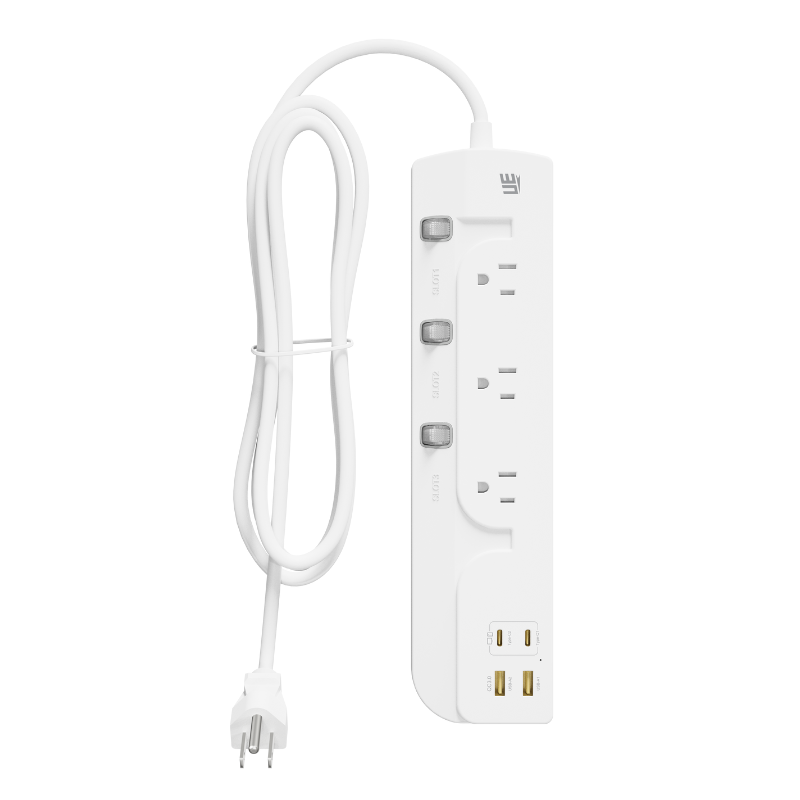
Many people plug expensive electronics into the cheapest multi-plug strips they can find. They assume any generic power strip offers a safe shield against electrical damage. This dangerous assumption can cost you dearly.
Modern households and offices run costly, sensitive gear. We rely on smart home tech, high-end monitors, and gaming laptops. We constantly push our local electrical limits. This multiplies the hidden risks of daily power consumption. A single electrical mishap can fry thousands of dollars of equipment in milliseconds.
This guide helps you navigate the confusing technical specs of modern power solutions. You will learn to tell the difference between external electrical threats like surges and internal threats like overloads. Armed with these details, you can evaluate your needs. You can confidently select the correct Extension Socket for your exact setup.
Key Takeaways
Surge protection defends devices from brief, high-voltage spikes (e.g., grid fluctuations, lightning), while overload protection prevents overheating and fire when devices draw too much continuous current (Amps).
A switch or an indicator light on an extension socket does not guarantee either surge or overload protection; independent verification of specs (Joules, Amp limits) is required.
For modern desktop setups, hybrid solutions like a GaN Extension Hub offer advanced thermal management, integrating high-speed USB-C charging with necessary circuit protections without the bulk of traditional power strips.
Understanding the Risks: Voltage Spikes vs. Current Overdraw
Consumers often blur the lines between different electrical safety features. We must separate external voltage spikes from internal current overdraws. Understanding this difference is the first step in protecting your property. Let us break down the exact mechanisms and threats associated with each.
Surge Protection (Defending Against External Spikes)
A surge protector acts as an electrical pressure relief valve. Its primary job involves monitoring the voltage coming from your wall outlet. When a sudden spike occurs, the device jumps into action.
Mechanism: The core component is usually a Metal Oxide Varistor (MOV). The MOV detects excess voltage. It rapidly diverts this dangerous excess into the grounding wire. This happens before the voltage can reach your connected electronics. The capacity of this defense is measured in Joules.
The Threat: People often worry about massive lightning strikes. However, the real danger usually comes from inside your own building. Major appliances like refrigerators, air conditioners, and laser printers cycle on and off all day. These cycles create micro-surges. Micro-surges send small spikes through your wiring. Over time, these spikes slowly degrade the microprocessors inside your computers and televisions. Eventually, the devices fail prematurely.
While surges involve excess voltage, overloads involve excess current. Every wire has a physical limit to how many Amperes (Amps) it can safely carry.
Mechanism: True overload protection utilizes an integrated circuit breaker. This breaker monitors the total current draw of everything plugged into the unit. If the draw exceeds the maximum rating (typically 13A or 15A), a bimetallic strip inside heats up. It bends and physically trips the breaker. This cuts the power entirely.
The Threat: Imagine plugging a space heater, a kettle, and a microwave into a single multi-plug unit. These resistive heating devices pull massive amounts of continuous current. Without an overload breaker, the internal wiring of the socket will overheat. The plastic casing can melt. In worst-case scenarios, the entire setup ignites, causing a devastating electrical fire.
Electrical Threats Overview Chart
Feature
Primary Threat
Measurement Unit
Defense Component
Surge Protection
Micro-surges, Lightning, Grid fluctuations
Joules / Clamping Voltage
Metal Oxide Varistor (MOV)
Overload Protection
Too many high-draw appliances
Amperes (Amps)
Integrated Circuit Breaker
The Misconception
A prevalent consumer blind spot exists in DIY forums and home improvement discussions. Users frequently assume an "overload switch" automatically protects against lightning. Conversely, they think buying a "surge protector" allows them to plug in an infinite number of space heaters. These are separate systems. A basic power strip might have an overload breaker but zero surge protection. A cheap surge protector might lack a true overload breaker. You must verify both systems independently.
Core Evaluation Criteria for a Reliable Extension Socket
Marketing claims often bury the actual technical specifications of power products. You need a concrete framework to evaluate these devices. Look past the flashy packaging. Focus on the actual numbers and compliance marks printed on the back of the unit.
Not all surge protectors provide the same level of armor. You evaluate them using two critical metrics: Joule rating and clamping voltage.
Joule Rating: Think of Joules as the total amount of energy the protector can absorb before it dies. Once the MOVs absorb their rated Joules, the surge protection vanishes. For basic desk lamps and alarm clocks, under 1000 Joules is generally acceptable. For expensive desktop PCs, gaming consoles, and home theater systems, you should demand 2000 Joules or higher.
Clamping Voltage (VPR): This is the specific voltage threshold at which the protector wakes up and starts diverting energy. Counterintuitively, a lower number is significantly better. You want the device to react quickly. A clamping voltage of 330V or 400V provides excellent, fast protection. If you see a rating of 500V or 600V, the device allows too much dangerous voltage through before reacting.
Verifying Overload Mechanisms
A simple on/off power switch means nothing for your safety. To verify actual overload protection, you must examine the hardware closely.
Look for a dedicated "reset" button on the side of the unit. Sometimes, the main power switch itself acts as the breaker. In this case, the switch will feel slightly springy and will physically click to the "off" position during an overload. Check the spec sheet on the back. It must explicitly state a maximum amperage limit, such as "15A Auto-Shutoff" or "13A Circuit Breaker." If these words are missing, assume the product lacks overload protection.
Material and Compliance Standards (Trust Indicators)
Internal electronics only tell half the story. The physical housing and regulatory testing matter just as much.
Fire-Retardant Casing: High-quality manufacturers use specific plastics. Look for V0-grade polycarbonate (PC). If an internal component sparks, V0-grade materials will self-extinguish within 10 seconds. Cheap plastics will simply melt and fuel the fire.
Regulatory Certifications: Never buy uncertified electrical equipment. In the United States, look for the Underwriters Laboratories (UL) mark, specifically UL 1449 for surge protectors. In Europe and the UK, ensure the product carries legitimate CE or UKCA marks. These symbols prove an independent laboratory tested the product under extreme stress conditions.
Traditional Extension Sockets vs. GaN Extension Hubs
The power delivery market has evolved rapidly over the last five years. You no longer have to settle for bulky plastic strips laying on your floor. Manufacturers now offer distinct solution categories for different environments.
The Legacy Extension Socket
The traditional horizontal strip still serves a vital purpose in many homes and commercial spaces.
Best for: These units excel at floor-level routing. They are perfect for behind the TV cabinet or under a workbench. They handle heavy-duty physical plugs and large transformer blocks where visual footprint does not matter.
Limitations: They are undeniably bulky. They collect dust. When you put them on a desk, they ruin the aesthetic. Furthermore, if you want to charge your modern devices, you still have to plug in separate, bulky charging bricks for your phone and laptop.
The Modern GaN Extension Hub
Desktop environments require a more sophisticated approach. Enter the modern hybrid power solution.
What it is: A GaN Extension Hub is a desktop-focused power solution. It utilizes advanced Gallium Nitride (GaN) technology. These hubs combine standard AC wall outlets with high-wattage USB-C and USB-A charging ports in one sleek unit.
Safety Advantages: Gallium Nitride conducts electrons much more efficiently than traditional silicon. Because it is efficient, it produces significantly less heat. This superior thermal management makes the unit safer. Furthermore, these hubs contain built-in smart chips. The chips communicate with your phone or laptop. They dynamically allocate power based on what the device needs. They provide highly intelligent, port-level over-voltage and overload protection.
Space Efficiency: A GaN hub transforms your workspace. It completely eliminates the need for multiple proprietary chargers. You do not need a massive MacBook brick, a separate iPad charger, and an iPhone block. You plug your USB cables directly into the hub. This reduces the risk of accidental overloading. It also removes physical cable stress, keeping your desk entirely clutter-free.
Decision Framework: Which Features Do You Actually Need?
You cannot buy a one-size-fits-all power solution. You must match the product to your exact implementation scenario. Use the shortlisting logic below to determine your ideal features.
Requirement: You need High-Joule Surge Protection combined with Overload Protection.
Reasoning: Gaming computers, network attached storage (NAS) drives, and OLED televisions represent significant financial investments. More importantly, they contain highly sensitive microprocessors. These microprocessors are incredibly susceptible to micro-surges. You need a heavy-duty protector with at least 2000+ Joules to act as a robust shock absorber for these specific devices.
Requirement: You need a GaN Extension Hub with Overload Protection and Moderate Surge Protection.
Reasoning: Your primary focus here is clean power delivery and workspace efficiency. You want safe, fast-charging capabilities without thermal throttling. A desktop hub gives you immediate access to power without crawling under the desk. It replaces messy bricks with direct high-speed USB-C ports while safely powering your monitor through the AC outlet.
Scenario C: High-Draw Appliances (Space Heaters, Microwaves, Power Tools)
Requirement: You need a Heavy-Duty Extension Socket with Strict Overload Protection.
Reasoning: Basic resistive heating elements do not contain sensitive microchips. Therefore, you do not actually need surge protection for a simple space heater. Your absolute priority is fire prevention. You must strictly adhere to the 13A or 15A limit. Emphasize heavy-gauge wiring (like 14 AWG or thicker) and a highly reliable mechanical circuit breaker.
Red Flags to Avoid
When shopping for power solutions, immediately reject products displaying these warning signs:
No Independent Safety Marks: Missing UL, ETL, CE, or UKCA marks indicates untested, potentially dangerous equipment.
Unspecified Joule Ratings: If the box claims "surge protection" but refuses to list the actual Joule number, it is likely a fake or useless component.
Flimsy Construction: If the plastic feels incredibly lightweight or bends easily, the manufacturer likely used dangerous, non-V0 grade materials.
Missing Ground Pins: Never buy a power strip with only two prongs. Surge protectors require the third ground pin to dump excess voltage safely.
Conclusion
An extension socket is never just a structural utility. It serves as the primary line of defense for your expensive hardware. Buying the cheapest plastic strip available exposes your home to micro-surges, thermal melting, and catastrophic fire risks.
Always remember the golden buying rule: Buy for the threat. Prioritize massive Joule ratings when defending sensitive data and gaming rigs. Demand strict, clearly labeled overload breakers for heavy appliance groupings. Finally, embrace modern GaN solutions to achieve superior desktop efficiency and thermal safety. Protect your investments by reading the technical specifications before you plug anything in.
FAQ
Q: Can I plug an extension socket into another extension socket (daisy-chaining)?
A: Absolutely not. Daisy-chaining extension units increases electrical resistance and generates dangerous amounts of heat. It effectively bypasses the mathematical limits of a single overload breaker. This practice violates fundamental fire safety codes and is a leading cause of electrical fires in offices and homes. Always plug a power strip directly into a permanent wall outlet.
Q: Does a glowing light on my extension socket mean my devices are fully protected?
A: Not necessarily. A glowing light usually indicates the unit is grounded or that the internal surge component (MOV) has not completely depleted yet. However, this light tells you nothing about the current overload capacity. Once a surge protector absorbs its maximum Joules, the protection dies. The light may go out, meaning your device now functions only as a basic, unprotected power strip.
Q: Do surge protectors expire?
A: Yes. The Metal Oxide Varistors (MOVs) inside surge protectors act like sponges. They degrade slightly every time they absorb a small grid fluctuation or micro-surge. Once they absorb their total Joule rating, they offer zero protection. Depending on the stability of your local power grid, you should proactively replace your surge protectors every 3 to 5 years.
UE Electronic is a power supplier integrating R&D, production and sales. We maintain a leading level in extension cord and GaN charger.We are committed to becoming a global power supplier.