Low-voltage deployments often fail at one predictable bottleneck. Installers rely on standard NVR PoE ports to power heavy-draw hardware. Pan-Tilt-Zoom (PTZ) cameras and multi-radio outdoor access points pull massive current. Connecting them to standard ports frequently results in frustrating boot loops or failed infrared (IR) activation. These failures compromise security and network reliability.
Evaluating power delivery for heavy-draw network devices requires moving beyond basic plug-and-play assumptions. You must calculate strict power budgets. You must understand cable distance limits. You also need to plan for robust environmental protections. Neglecting these factors leads to hardware degradation.
This guide provides a vendor-neutral decision framework for selecting the correct power infrastructure. We will specifically assess when you should use a dedicated PoE injector for PTZ camera setup. We will also compare this approach against upgrading your core switches or pulling local power. You will learn how to stabilize your network and protect your expensive outdoor equipment.
Key Takeaways
Standard NVR PoE ports (15W/30W) generally fail to support the motor, heater, and IR power spikes of modern PTZ cameras.
An IEEE 802.3bt PoE injector (60W/90W) is the industry standard for isolating high-power device loads without replacing existing network switches.
Ethernet surge protectors do not supply power; they must be paired sequentially with an outdoor AP power supply or injector and properly grounded to prevent equipment failure.
Vendor proprietary power standards should be avoided in favor of strict IEEE compliance to ensure long-term hardware interoperability.
The Power Problem: Why Standard Switches & NVRs Fail PTZs
Engineers design NVRs and standard PoE switches for aggregate low-draw devices. You usually connect fixed IP cameras, VoIP phones, or basic indoor wireless access points to them. These devices pull a steady, predictable load. Standard switches handle them perfectly. They allocate a modest power budget across all 24 or 48 ports. However, this model breaks down completely when you introduce heavy-duty hardware.
Modern PTZ cameras do not pull a steady load. They generate massive power spikes during specific operational phases. We call this the "PTZ Power Spike" reality. A standard 30W port cannot survive these transient loads. The switch detects an overcurrent draw. It then shuts down the port to protect itself. You must understand the specific actions triggering these port shutdowns.
Pan/Tilt motor initialization upon boot: When a PTZ first receives power, it calibrates itself. It spins its internal motors rapidly to locate its home position. This mechanical movement demands an immediate, massive surge of current.
Internal heater/blower activation: Outdoor deployments face extreme weather. Sub-zero temperatures risk freezing the lens mechanisms. The camera activates internal heaters to melt frost. These heating elements act like resistors, draining significant wattage instantly.
High-intensity IR illuminator activation: Nighttime transitions pose another hurdle. When ambient light drops, the camera turns on long-range infrared LEDs. Pushing IR light 150 meters into the darkness requires incredible electrical power.
The operational cost of failure remains high. Intermittent camera resets often happen during critical recording moments. An intruder triggers the motion sensor. The camera activates its IR array and attempts to pan. The sudden power draw overwhelms the NVR port. The camera reboots, and you lose crucial video evidence. Alternatively, you might experience a localized switch failure. If several PTZs power on simultaneously after a facility outage, they exhaust the total overall switch PoE budget instantly.
Evaluating Core Power Delivery Approaches
You have three primary ways to deliver heavy wattage to outdoor network equipment. Each approach carries distinct advantages and operational risks. System integrators must evaluate them based on scale, existing infrastructure, and physical site constraints.
Scenario A: The Upgraded PoE++ Switch
Upgrading your entire network edge to PoE++ (IEEE 802.3bt) switches offers a clean topology. You replace your older 30W switches with newer models capable of pushing 60W or 90W per port.
Pros: This provides centralized management. You can remotely reboot devices via the switch interface. It also streamlines cabling. You only run one Ethernet cable from the rack directly to the camera.
Cons: This requires high capital expenditure. Upgrading a 48-port switch just to support two heavy-draw PTZs wastes money. It also introduces a total-loss risk. Pushing extreme wattage creates intense heat. If the internal switch power supply fails, your entire camera network goes offline.
Scenario B: Dedicated PoE Injector Setup
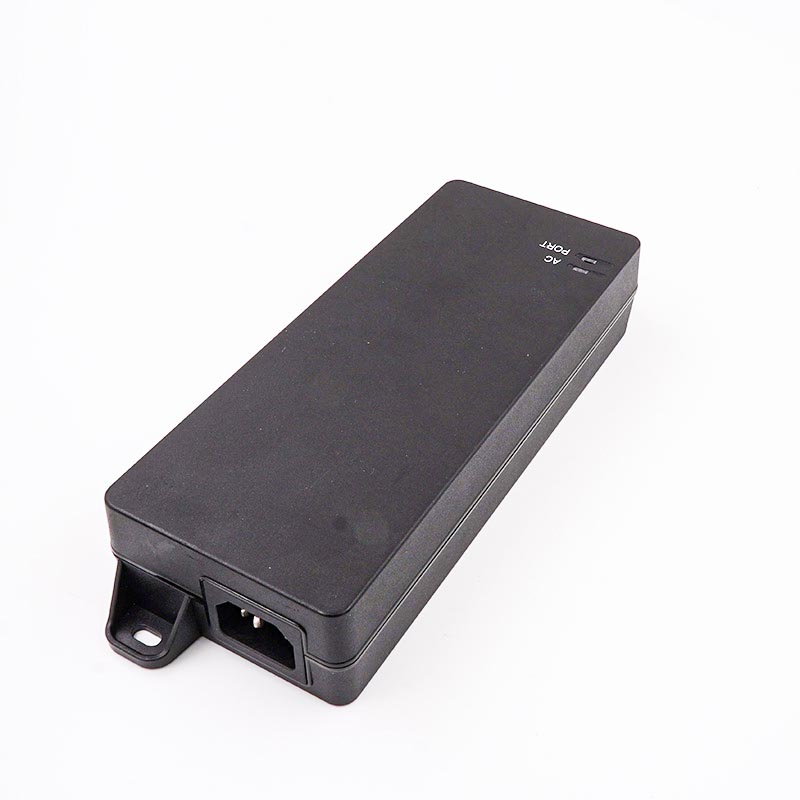
A midspan injector bridges the gap between older networking gear and new, hungry cameras. You place the injector between your standard network switch and your endpoint device. It merges network data from the switch with fresh DC power from a wall outlet.
Pros: This offers highly cost-effective bridging. Installers keep their standard non-PoE or low-PoE switches. They deliver isolated, high-wattage power strictly to the required cable runs. This isolates the high-power load from your expensive core routing equipment.
Cons: An injector adds physical footprint. You must mount it in your server rack or a weatherproof NEMA enclosure. It also requires an independent AC outlet nearby to function.
Scenario C: Local AC/DC Power
Sometimes you bypass Ethernet power delivery entirely. You run data via fiber optic cable or standard Ethernet, but supply power directly at the pole. You mount a surveillance camera power adapter right next to the camera in a junction box.
Pros: This method bypasses Ethernet distance limitations. PoE suffers from voltage drop over 100-meter runs. Localizing the power adapter guarantees the camera receives maximum voltage regardless of the data cable length.
Cons: You often need a licensed electrician. Pulling high-voltage 110V/220V lines to an outdoor mounting pole demands permits and conduit. You completely lose the "single cable" deployment advantage of standard network setups.
Power Delivery Approach Comparison
Approach
Ideal Use Case
Primary Advantage
Primary Drawback
Upgraded PoE++ Switch
Deploying 10+ high-draw devices per rack.
Centralized remote management.
High upfront equipment costs.
Dedicated Midspan Injector
Upgrading 1-4 specific cameras/APs.
Cost-effective power isolation.
Requires additional AC outlets.
Local AC/DC Adapter
Cable runs exceeding 100 meters.
Eliminates DC voltage drop issues.
Requires high-voltage electrical work.
Specifying the Right Injector: 90W, IEEE 802.3bt, and Passive vs. Active
Not all injectors operate the same way. The market floods buyers with cheap, non-compliant options. Choosing the wrong specification will permanently damage your surveillance hardware. You must understand the negotiation mechanisms and wattage classes.
You must heed the warning between active and passive power. Cheap "passive" injectors force constant voltage down the Ethernet cable. They do not check if the camera actually needs power. If you plug a laptop into a passive injector port by mistake, the forced 48V current will fry the network card. Active (negotiated) PoE remains mandatory for enterprise evaluation. Active injectors communicate with the device first. They verify a valid resistance signature before sending any current.
We must decode the IEEE standards for high-draw devices to ensure correct hardware matching. The Institute of Electrical and Electronics Engineers sets strict compliance rules.
802.3af (15.4W) & 802.3at (30W): These represent older standards. They remain sufficient for indoor fixed domes or basic bullet cameras. They are entirely insufficient for motorized PTZs.
802.3bt Type 3 (60W): This serves as the standard baseline for basic outdoor PTZs. It also powers modern multi-radio WiFi 6 outdoor APs perfectly. It uses all four wire pairs in the Cat6 cable to transmit power.
802.3bt Type 4 (90W): This highest tier is strictly required for advanced equipment. If your PTZ features integrated mechanical lens wipers, heavy-duty heaters, and long-range laser IR, you need Type 4.
Apply a strict evaluation lens during procurement. When procuring a 90W PoE injector, verify the Powered Device (PD) signature handshakes correctly. Document your assumptions about voltage drop across long runs. A 90W injector guarantees 90W at the source output. However, copper cable resistance dissipates energy as heat. Standard physical limits mean only about 71W actually arrives at the camera at a 100-meter distance. Always account for this 19W transmission loss when calculating your power budget.
Outdoor Implementation Realities: Surge Protection and Grounding
Powering an outdoor device introduces severe environmental risks. Lightning strikes and static accumulation destroy thousands of cameras annually. Many installers misunderstand the hardware required to prevent this.
We must clarify a common field confusion found in contractor forums. A surge protector does not inject power. An injector does not arrest surges. They perform completely different jobs. A surge protector clamps excessive transient voltage and redirects it to the earth. An injector pushes safe DC power to the camera. You cannot use them interchangeably. You must deploy them together for outdoor equipment.
Follow a strict installation topology to protect your network core. The correct physical sequence is critical. It must flow exactly like this:
Step 1: Network Switch (Data only)
Step 2: Midspan PoE Injector (Adds power)
Step 3: Ethernet Surge Protector (Clamps spikes coming from outside)
Step 4: Outdoor Endpoint Device
Grounding requirements dictate the success of this entire setup. A high-end PTZ injector or a premium router means nothing if you neglect earth grounding. The surge protector requires a direct, low-impedance path to the earth. If you screw the ground wire into painted metal or a floating rack, the surge has nowhere to go. It will jump the gap and travel down the Ethernet cable. This destroys your switch. Improper implementation also causes ground loops. Ground loops introduce electrical noise, which degrades video quality and disrupts network packets.
Shortlisting Logic & Next-Step Actions
Moving from theory to procurement requires a systematic approach. Do not guess what your devices need. Guessing leads to overheating cables or underpowered cameras.
Always start with a comprehensive device audit. Check the manufacturer datasheet for your camera or AP. Look specifically for "Max Power Consumption." Do not look at "Typical" or "Average" draw. Typical draw ignores the IR LED activation and motor start-up spikes. Once you find the Max Power figure, add a 15-20% buffer. This buffer accounts for the cable resistance and voltage drop over long Ethernet runs.
Next, verify your infrastructure compatibility. Older Cat5e cables possess thinner copper conductors. Pushing 90W of continuous DC current through thin copper generates serious heat. If you bundle dozens of these cables tightly in a tray, they cannot dissipate heat. They exceed thermal limits, melting the jacket or degrading data transmission. Upgrading to solid copper Cat6 or Cat6a cabling mitigates this thermal risk entirely.
Your immediate actionable next step involves building a localized spreadsheet. Map every outdoor device to its specific power requirement and cable distance. If you are deploying fewer than four high-draw devices per network closet, shortlisting dedicated 802.3bt midspan injectors yields the highest return on investment. This approach avoids upgrading your entire switch chassis while guaranteeing isolated, safe power delivery. You isolate the heavy loads and minimize overall network disruption.
Conclusion
Powering an outdoor PTZ or a heavy-duty access point is not a mere plug-and-play afterthought. It represents a critical infrastructure decision. Treating it casually results in offline security systems and damaged network hardware. You must calculate voltage drops, map your surge protection topology, and isolate heavy loads from your standard switches.
Relying on strict IEEE 802.3bt compliance ensures system scalability and safety. Avoid cheap passive injectors and proprietary vendor power methods. Using standardized, active midspan injectors guarantees that your devices communicate their power needs safely. By matching the right injector wattage to your camera's maximum peak draw, you secure your hardware against brownouts. Plan carefully, prioritize proper grounding, and your outdoor deployments will achieve flawless operational uptime.
FAQ
Q: Can I run a PTZ camera directly from my NVR's PoE ports?
A: Usually no. Most NVRs supply a maximum of 30W (PoE+) per port, and often share a strict total power budget. A heavy-duty PTZ pulling 40W+ during IR/motor startup will overload the NVR, causing device resets.
Q: What is the difference between a PoE injector and an Ethernet surge protector?
A: A PoE injector introduces DC power into the Ethernet cable to run the camera. A surge protector clamps excessive voltage (like lightning-induced transients) to ground to prevent equipment damage. They are distinctly different but should be used together outdoors.
Q: Can I use a 90W PoE injector on a camera that only needs 30W?
A: Yes, provided it is an Active (IEEE-compliant) injector. The IEEE 802.3 standard negotiates power delivery, meaning the injector will only supply the 30W the camera requests, preventing hardware damage.
UE Electronic is a power supplier integrating R&D, production and sales. We maintain a leading level in extension cord and GaN charger.We are committed to becoming a global power supplier.